
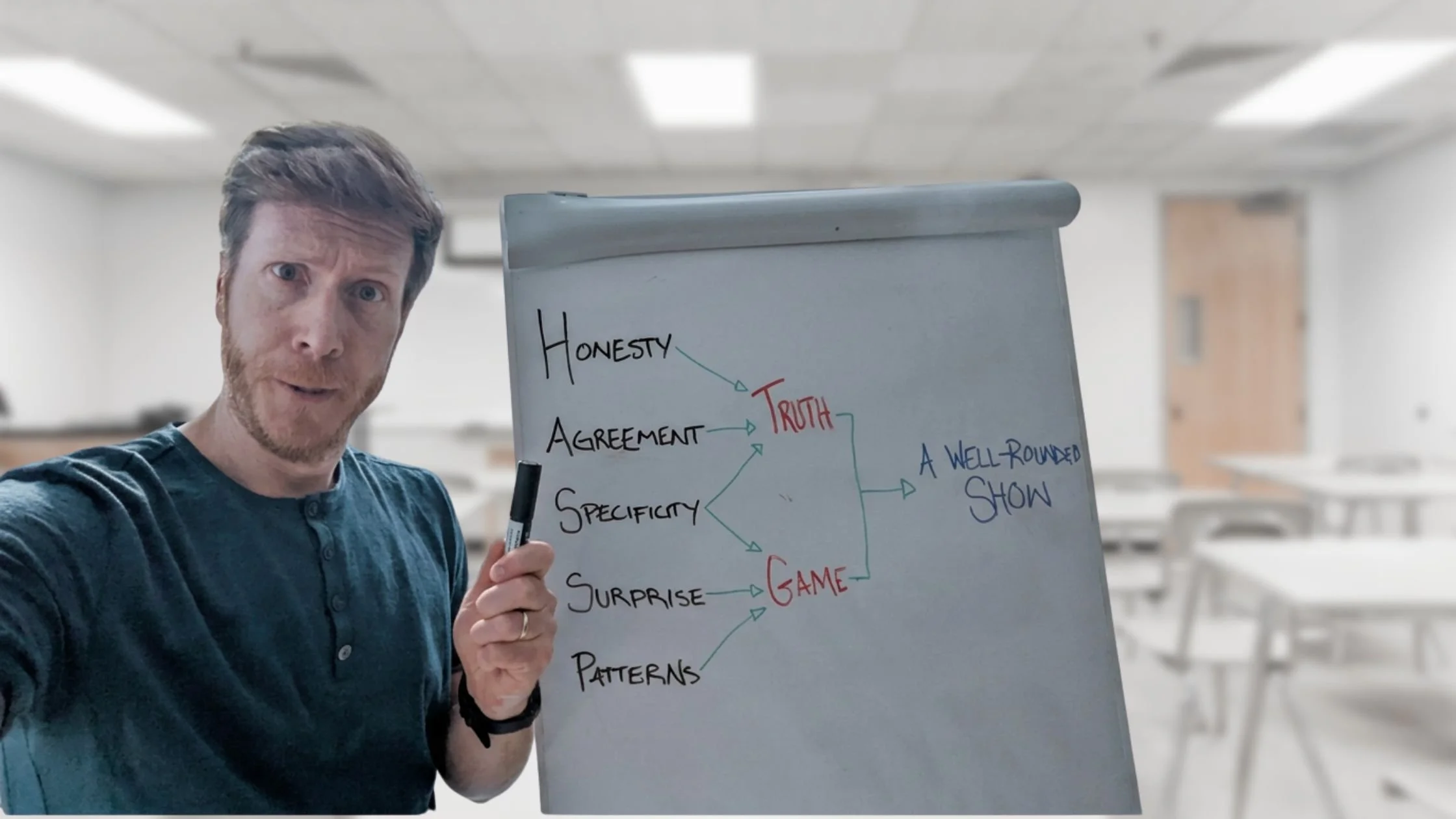
There are five things an improviser can adhere to, to ensure a connection with their audience. A connection that elicits a response. By “response” I mean, most of the time, “laugh”. These things are partly, as far as I can tell, first outlined in Improvisation at the Speed of Life by TJ and Dave. However, for the benefit of the reader, I have centralized these pillars, expanded on them and have attempted to draw from them an understanding of what they are individually and how they work in concert to draw out the ‘Truth of the Scene’ and the ‘Game of the Scene’. Two sides of the same coin; necessary for a well-rounded show. This may or may not be a purely academic exercise, an attempt to draw out points I find important. But learning good sometimes!
Here they are in a specific order but not a hierarchical order. We could also read this from bottom to top.
Honesty
Agreement
Specificity
Surprise
Patterns
But first, why are these “things” “unassailable”? As much as I’d love to be a paragon of culture, I understand that an absolute like “unassailable” is likely to ruffle feathers. Who am I to say what’s right when dealing with something as taste-based as entertainment?
But that’s just it; I am purposefully taking that position, not from a holier-than-thou perspective but from a fact-based perspective. I mean it when I say “unassailable” as much as saying, “you can’t have rain without clouds”. You cannot connect with an audience without honesty, agreement, specificity, surprise and/or patterns. If you can truly achieve at least one or some combination of these things, then you have made a connection, however fleeting.
I’m not even saying that you need to do it a certain way! Even the artists you are most critical of have done this. They have connected to their audience… that’s why they have an audience. I’m simply saying, “if you’ve paid attention to these things and you’ve made use of them at all, then you will have formed a bond with someone in the audience.” It's a fact.
I should also mention that while I think these are important across all disciplines, I’ll be focusing on how they fit within the Long Form Improv we teach at The CCB Training School. I realize that in doing so I’m in some ways carving out a niche distinct from other schools of improv thought, like short form, competitive, narrative and maybe even dramatic improv (don’t get me started).
Let’s begin with each of these individually:
Honesty
It seems strange to have to explain this, but alas, an audience, by nature, is attracted to honesty. If it’s true, or truthful, it has cache. Think, “it’s funny because it’s true.” An audience will listen to you if you’ve said something authentic, something they can believe in.
Honesty goes well beyond saying something true, though. In fact, most of the time, as improvisers we’re not saying anything that is true for us. And that may be the fault line for improvisers failing to live up to this standard: It’s less about whether it’s true and more about whether it’s truthful. A strong improviser may never have been a doctor, but can play one honestly; may never have been arrested, but can honestly portray the feeling of being hauled off; may never have experienced the death of a loved one, but can honestly conjure up the gut wrenching emotions of loss; may never have floated in mid-air, but can show us the joy of that experience.
They are able to answer the question: If this were true what would one do?
Agreement
A basic building block of improv, sure, but a fundamental tool in any group creative endeavor (I’ll even include solo creative endeavors). Agreement is the most under-utilized tool for improvisers who plateau or get locked in their head. Never underestimate the power of nodding your head and saying “yeah!”. Similarly, you’ll never have as much fun on stage than when you and your scene partners are all on the same page, vibing and jibing, completing each other’s… “sentences!” and reading each other’s minds. Games, patterns, fun; they are all derived from our ability to gel with one another. Working in concert to achieve something together. Group flow state! It’s a thing.
And remember, as I mentioned earlier, no one likes to watch people struggle. So it stands to reason that what people do like is the opposite: play, fun… agreement. We, as humans, in part, like to watch people getting along and having fun doing so. The audience senses when an ensemble is on the same wavelength just as they can sense when they’re not, because they can see the very person who has checked out, bailing on whatever group activity was unfolding.
We can see this in action when we see a jazz band taking turns supporting the soloist, or a basketball team (or whatever high level sports team) passing the ball, working seamlessly together to score points and of course when our favorite improv group all seem to say the same funny thing at the same time. We even see this in solo endeavors, where an artist’s work is wholistic, never at odds with itself, particularly evident in narrative forms where pieces fall into place, syntax and style match a particular tone, characters make sense in the story. Think Cormack McCarthy’s stripped away punctuation in The Road mirroring the stripped away landscape of a post apocalypse.
What tricks the improviser though is the chasm that can open between attempting to be agreeable and truthful at the same time. It is the appearance of “yes” that belies the sincerity of a moment. Sometimes it is truthful to say “no!” and that is agreement!
Oh! and another trapdoor: Honesty is not shorthand for “real”. For those afraid or dismissive of honesty, remember that if an audience doesn’t believe in your absurd character in some small way they won’t be entertained by them. Even though they could never exist in our reality there still needs to be honesty. And for those who think honesty must mean reality and therefore improv is more than comedy, I would agree with you. Improv that focuses on fundamentals and leans on these 5 things are not focusing on comedy. Comedy is a side effect of good improv. The focus has to be on good improv. I subscribe to this completely. TJ and Dave said it already:
We don’t waste time contemplating how to amuse an audience. The audience laughs at agreement and specificity. They laugh at surprise.
-Improvisation at the Speed of Life, Page 64
So when you set out to improvise with the mindset that improv isn’t comedy and isn’t supposed to be funny, you are rejecting the basics of good improvisation. (I told you not to get me started on dramatic improv).
Specificity
By ‘specificity’ we mean ‘be detailed’, sure, but more than that too. In improv, specificity breathes life into our character and our worlds. It comes from our ability to commit, care and know what is going on. By being specific you’re no longer playing some amorphous archetypal character but an actual person that has thoughts and feelings. And many times thinking specifically first actually helps us care and know about our characters better! Specificity is the difference between making a choice and not making one. Because if you’ve failed to get specific about something you might have just as well not said anything at all. The work of clarifying what you mean still needs to be done. Being specific opens doors for us. One specific choice easily leads us to the next thing. And a specific thing is easily revisited. Helpful for patterns (see below)!
Specifics in dialogue is often how we understand and try to achieve this, but it also includes how our characters are, physically, in space and sets our object work apart from the mimes on one end and the yuck-yucks on the other. How an improviser might try to pull out a piece of tape, struggling to find the end on the roll can impart a huge amount of meaning into a scene, but only if done with careful specificity.
But equally important, specificity is clarity. Clarity is simple. Simplicity is good.
Surprise
Surprise is the ‘unexpected’. It is the spice of life. “I didn’t see that coming!” It’s also that thing that can keep us on our toes. An improviser that keeps us on our toes is the one who makes bold choices.
For anyone who understands “Game of the Scene” knows that this is often the catalyst of a pattern; it is our first “unusual thing”. These moments of discovering something big tend to send the scenes in fun directions. They set in motion scenes, patterns and big characters.
You’ll know these moments because often you will break character with excitement and laughter. Or better yet, you’ll make your scene partner laugh and break character. And even better, you’ll make the audience laugh. Like, really hard.
A surprise always seems to make sense as well; an unexpected move that fits seamlessly with what’s going on. Partially that has to do with an improviser’s ability not to be rattled by the surprise but to take it on with grace and agreement. A surprise untethered from the scene is random. Random sends us to Crazytown, where anything goes and anything can and will happen without causality. It’s really hard to make connections with the audience in Crazytown. I’ve tried.
Patterns
Baked into our DNA is the mind and the eye that looks for repetition and patterns. It’s as natural as Fibonacci’s Sequence. The beauty of predictability. The wonder of a spiral seashell or romanesco Brocolli. We find comfort in routine and delight when the routine is improved. We also find wisdom, growth and profundity in patterns that are broken.
Surprise often comes at the beginning of a pattern setting it off, and surprise shows up at the end of a pattern, capping it off.
And patterns don’t happen unless there’s agreement! Otherwise these birds just crash into each other rather than forming a brilliant display:
Just as finding patterns are primal so too are a human’s tendency to lump everything into a category. Here’s my attempt to convince you all that I am human as I attempt to categorize these five things into neat tracks that lead to a well-rounded show:
The Truth of the Scene
I started with Honesty and Agreement because these two pillars lend themselves most clearly to what’s referred to as the “Truth of the Scene”. The Truth of the Scene is the idea that there is reality in any improvised scene and the job of the improviser is to discover what that reality is by letting it reveal itself through listening and presence and we react to these moments with Honesty and Agreement. And we can be more authentic and better team players through Specificity
The Game of the Scene
I started the bottom of the list with Patterns and Surprise because these two pillars lend themselves most clearly to what’s referred to as the “Game of the Scene”. The Game of the Scene is the idea that there is something funny in a scene and the job of an improviser is to focus on that funny thing and make it funnier. Or, if you recoil at the word “funny” you can replace it with “interesting”. There is something interesting in a scene and the job of the improviser is to explore and heighten that interesting thing. We do that by recognizing Patterns and leaning into Surprise by making bold choices. And we can be better at finding a pattern and pack more punch in our choices if we’re being Specific.
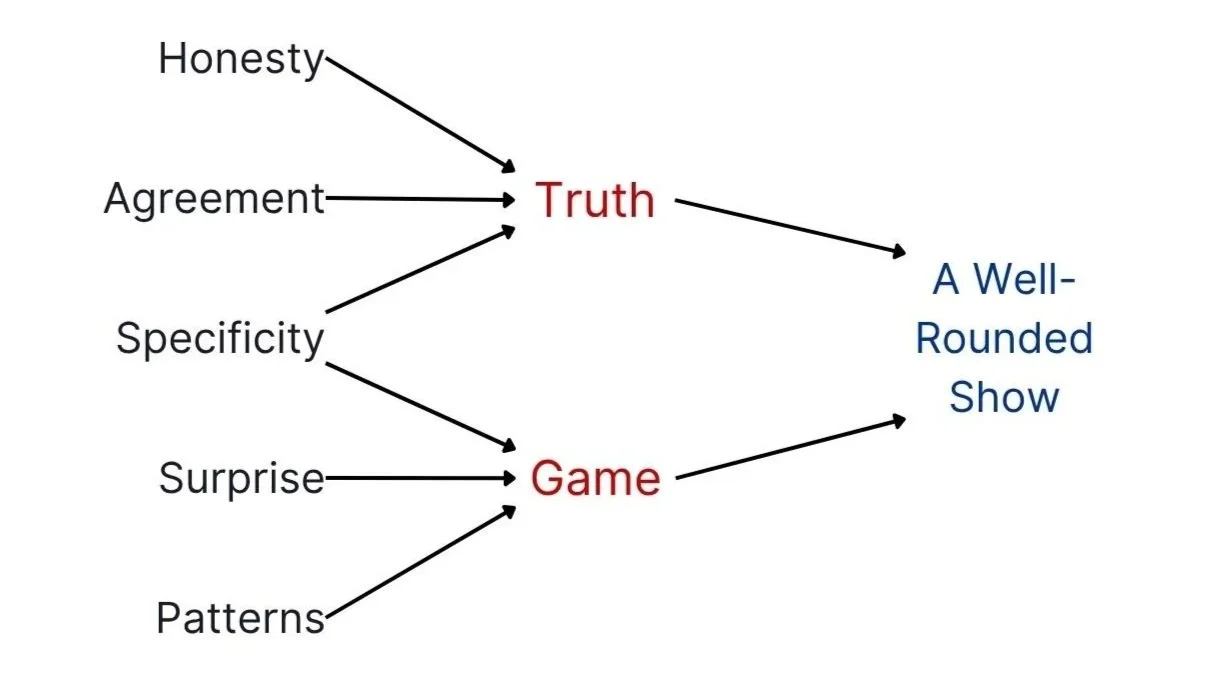
For the visual learner.
A well-rounded show
After watching half-a-million improv shows, it’s my humble feeling that a team of improvisers that embody these five things tend toward a more successful show (successful show = audience response = laughter – for the most part). We can see these things embodied partly when improvisers give depth and reality to their scenes and characters and partly when scenes are focused on exploring something interesting (funny, unusual). Some teams put their emphasis on Truth of the Scene (see Bear Milk at CCB) and some on Game (see Action Jackson, shameless plug, I’m on that team), but by and large there are elements of both. A show that ignores Truth feels crazy for crazy’s sake; anything is a pattern and nothing feels relatable. A show that ignores Game lacks urgency and awareness that an audience is watching. It’s flat and boring. It’s a flatlining heart rate monitor that’s not even sounding off that someone is dying. Just a quiet, straight, green line.
I’m tempted to end this piece right there, on the flatlining heart rate monitor.
A lot of this comes from the ethos that forms the keystone to The CCB Training School my brother Josh Telson and I run. We’ve forged these ideas in the years performing, teaching and absorbing improv in Berlin and elsewhere. Credit to him for helping shape this ideology. And thanks to Alice Schmid who I have bounced ideas off of on many occasions and helped me put these 5 things in the right order.